
Route 1 of 5
Indrebyen
Indrebyen lies in the west of Vadsø, with Havnegata, Nyborgveien and the old quays. The area was spared total destruction in 1944, so around 700 houses from before the war are still standing here — most of them characteristic Varanger houses.
- Stops
- 10 stops
- Distance
- approx. 3 km
- Time
- 1–1.5 hours
- Start
- Bietilægården
- Finish
- Samvirkekaia
Bietilægården
The start of Kjærlighetsstien (the Lovers’ Path). Bietilægården is a farm with a quay from the 1880s. The first people to live in the house came from Kemi in Finland. Since then, several families have lived there at the same time. They made their living from fishing, farming and carrying freight by boat. In the early 1900s the farmhouse got its present appearance, with a touch of the Swiss chalet style. The building is typical of the architecture that shaped Vadsø before the Second World War. The house stood empty for several years and was almost ruined. It was listed in 1990, and has been restored with funding from the Directorate for Cultural Heritage (Riksantikvaren) under the direction of Finnmark County Council. Bietilægården was handed over to Vadsø Municipality in December 2003, and now belongs to Vadsø museum – Ruija kvenmuseum.
Source: Vadsø museum – Ruija kvenmuseum
Prestelvkaia
Prestelvkaia, or Fabrikkaia (the Factory Quay), is probably the oldest quay in Finnmark. It was built by Esbensen when the guano factory at Prestelva was set up. Some of the buildings and parts of the quay burned down in 1907, but were rebuilt. Drawings of the original site show that there were once four buildings, but three of them were destroyed during the war. After the war the building was used as, among other things, a prawn factory and a factory making fish products. The quay and the quay building have been restored.
Source: Vadsø museum – Ruija kvenmuseum
→ From Ackermann Olsen’s house we recommend walking back along Nyborgveien, turning left into Prost Balkes gate and carrying on across Havnegata along the footpath by the fjord. If you have time, drop in at the bird hide (Fugletitterskjulet).
Møllesteinene (the Millstones)Stone Age settlement by Prestelva
Settlement from the Late Stone Age, around 3000–2500 BC, has been recorded at Prestelva. See the information sign by Møllesteinene at Prestelva.
Source: Vadsø museum – Ruija kvenmuseum
Prestelva
Prestelva is at the western end of Havnegata. The river has had many names: first Lilleelva (the Little River), then Mølleelva (the Mill River) and finally Prestelva (the Priest’s River), after the vicarage was built there. People were already living in the area in the Stone Age. A grain mill was set up in the 1700s, linked to East Finnmark’s main grain store. From 1872 until the Second World War, a guano factory operated at the mouth of the river. The factory made meal from fish waste for use as fertiliser. Until 1963 the river marked the boundary between the town municipality of Vadsø and Nord-Varanger municipality.
Source: Vadsø museum – Ruija kvenmuseum
Varanger houses in Havnegata
Indrebyen and Ytrebyen in Vadsø were spared total destruction during the Second World War. That is why there are many older houses here — around 700 from before 1944 — and the buildings still have an old-fashioned character. Most of them are what are known as Varanger houses, a type of house that developed under influence from Karelia and the White Sea, with the dwelling and the cowshed under the same roof.
Source: Vadsø museum – Ruija kvenmuseum
Tiberghuset (the Tiberg House)Havnegata 67
The house was built by Nils Tiberg in the 1840s and is one of the oldest houses in Vadsø. The first Laestadian meetings in Vadsø were held here from the 1860s. The widow Helene Tiberg owned the house into the 1900s, when she sold it to the Berævara family. The house is probably the oldest in Vadsø today, and is privately owned.
Source: Vadsø museum – Ruija kvenmuseum
Russebakeriet (the Russian Bakery)Havnegata 49B
The house was originally a Kven farm from the 1850s. Isak Tiberg from the Torne Valley built it from solid Russian planks, and it got its name when it was fitted out as a bakery. The bakery sold large quantities of bread to the Russian sailors and skippers who traded in Vadsø during the Pomor era, which lasted until 1918.
Source: Vadsø museum – Ruija kvenmuseum
Esbensengården på BakkenNyborgveien 33
In Vadsø, the Esbensen family can be traced back to the second half of the 1700s (see Esbensengården in Ytrebyen, no. 26). They became one of the most powerful merchant families in Varanger. The Esbensen house here at Bakken was put up at the end of the 1890s. It was moved from Mortensnes, further up the Varangerfjord, where it had been the main building of the merchant Nordvi from the 1830s. The house got its present Swiss chalet style when it was re-erected in the 1890s. The house is privately owned.
Source: Vadsø museum – Ruija kvenmuseum
Ackermann Olsen’s houseNyborgveien 23
Built in 1884 and extended around 1900, the house is in the Empire style, typical of the middle classes and officials in Vadsø in the 1800s. During the war German lodgers lived here, and later there was a watchmaker’s workshop in the house. Trygve Ackermann Olsen was the last of the family to live in the house before it was restored in the 1970s. The house is privately owned.
Source: Vadsø museum – Ruija kvenmuseum
Samvirkekaia
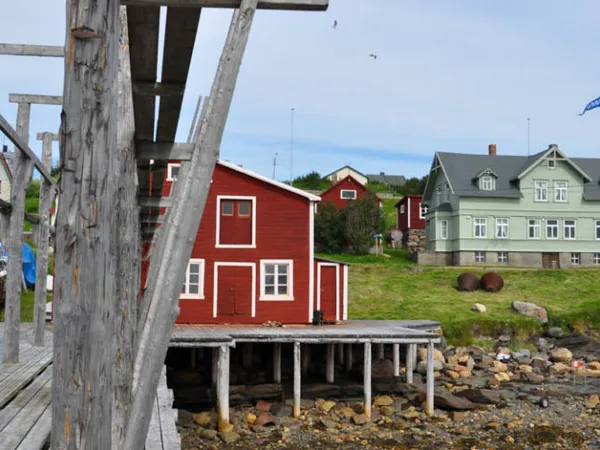
Samvirkekaia is made up of two baiting sheds, a warehouse, a post-war reconstruction hut and a double net-drying rack, all put up just after the war. Fishermen use the site for storage and for baiting their lines. There are berths for the fishing fleet at the quay. It is the only site in town today that is still tied to the sea and commercial fishing. The quay is owned by Vadsø Municipality.
Source: Vadsø museum – Ruija kvenmuseum