
Route 2 of 5
Town centre
Vadsø town centre was completely destroyed by Allied bombing in August 1944, so the buildings here are post-war reconstruction architecture from the early 1950s. The church, the town hall and Statens hus are the most distinctive buildings.
- Stops
- 6 stops
- Distance
- approx. 1 km
- Time
- 45–60 min
- Start
- Hermetikkfabrikken
- Finish
- Finnmarksbiblioteket
Hermetikkfabrikken (the Cannery)Tollbugata 7
The factory was built in the 1950s. The premises were originally a fish factory, and one of the first to can prawns and other fish products. The building and the quay fell into disrepair from the late 1970s, but were saved and restored in the early 2000s. «Hermetikken» became «Hermetikken kulturnæringshage», a business incubator for the creative industries. However, several of these businesses have since moved out and set up in Bankbygget, formerly Sparebank-EN.
Source: Vadsø museum – Ruija kvenmuseum
Tollbugata / Torget (the Square)
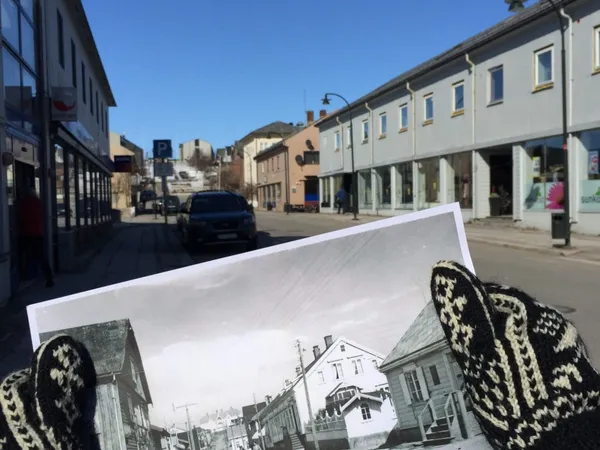
Tollbugata, the town’s main street, is named after the customs house established in 1834, a year after Vadsø gained its town charter. In 1858 a new customs house with a warehouse was built at the bottom of the street. This was also the site of Fløttmandsbryggen, the wharf where ferrymen rowed people to and from the ships lying at anchor out in the harbour. The street runs through the oldest settled area on the old Skatøre, the southern tip of the town. The oldest vicarage on the mainland, from the 1680s, probably stood in this street. The homes of ordinary townsfolk lay furthest north, around today’s Torget (the Square). The area around Torget became a purely commercial district with shops and warehouses. During the Second World War the street was completely destroyed, and it was laid out anew during the reconstruction. The town hall was built in 1951–52 to designs by the architect Rolf Ivar Øverlid.
Source: Vadsø museum – Ruija kvenmuseum
The Immigrant Monument / The Kven Monument
The monument was unveiled on 18 June 1977 by King Olav, in the presence of King Carl Gustaf of Sweden and President Urho Kekkonen of Finland. Through this memorial, the Kvens — the Finnish immigrants — were made visible as a distinct group, and their historical importance was recognised. The monument is the work of the Finnish artist Ensio Seppänen.
Source: Vadsø museum – Ruija kvenmuseum
Statens hus
The County Governor’s administration building from the early 1960s, designed by the architects Turid and Kristen Bernhoff Evensen. The complex consists of two rectangular blocks with pitched roofs, one taller and longer than the other, joined by a lower linking building with the entrance. Statens hus stands on the site of the grand Amtmannsgården (the County Governor’s residence) from 1895, which was burned in 1944.
Source: Vadsø museum – Ruija kvenmuseum
Vadsø Church
Vadsø Church was consecrated in 1958. It is the fourth church in Vadsø. The third church, designed by C. H. Grosch in 1861, was burned as the Germans retreated in 1944. In the reconstruction plan drawn up by the architect Borchsenius in 1947, the new church was proposed for the old site. The nave was laid out on a north–south axis, unlike the east–west orientation of the old church. The church was designed by the architect Magnus Poulsson. He called it an Arctic Ocean church (Ishavskirke), which you can see from the entrance, where the church door sits between two towers that look like great icebergs. The building is made of concrete and seats 480. The decoration is by Grete Thiis Schjetne.
Source: Vadsø museum – Ruija kvenmuseum
Finnmarksbiblioteket
The distinctive white masonry building in Idrettsvegen, behind Samfunnshuset (the community centre), is Finmarksbiblioteket, which opened in May 1926. The Finmarksbiblioteket institution was founded in 1892 as a specialist library for all writings relating to the history of Finnmark — in other words, an archive. The archive was moved to Aust-Finnmark County Library in 1964. There was talk of demolishing the building at that time, but the local housewives’ association (Husmorlaget) saved it and opened the town’s first nursery there. Today the building is used as a meeting place for Kvinne- og familielaget (the women and family association) and the local crafts association (husflidslaget).
Source: Vadsø museum – Ruija kvenmuseum