
Route 4 of 5
Ytrebyen
Ytrebyen, in the east, also came through the war relatively well and has kept many of its 19th-century buildings. Here you will find two museum farms, the sea sheds at Ytrebyfjæra and the mysterious Ivarsteinen (the Ivar Stone).
- Stops
- 6 stops
- Distance
- approx. 1.7 km
- Time
- 1 hour
- Start
- Post-war reconstruction housing (Idrettsveien/Bergstien)
- Finish
- The sea sheds at Ytrebyfjæra
Post-war reconstruction housing
The residential areas in Midtbyen towards Ytrebyen were damaged during the war. New reconstruction houses were built here, in Idrettsveien and Bergstien in Vadsø. The house types and buildings developed just after the war and built between 1945 and 1960 have a style of their own, known as reconstruction architecture (gjenreisingsbebyggelse). It was a distinct building era in Nord-Troms and Finnmark — «the regulation of the burnt places».
Source: Vadsø museum – Ruija kvenmuseum
Esbensengården på SlettenHvistendahlsgt. 31
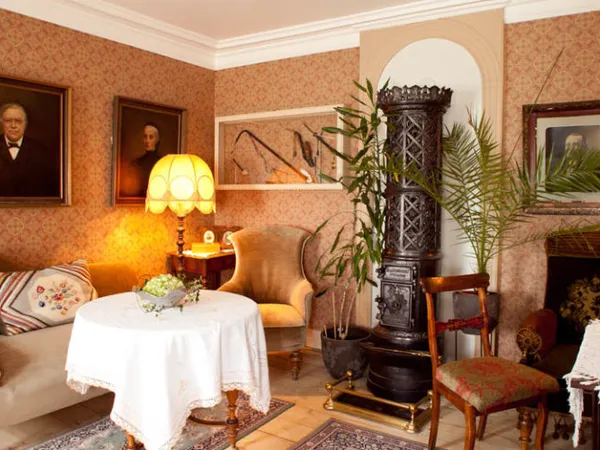
Esbensengården is a Norwegian merchant’s house from 1850, sold to Vadsø Municipality in 1976 and restored as a museum. The first Esbensen came from Denmark in 1764 as a servant in the King’s trading company. When trade was freed in 1789, he set up a large private trading house in the centre of Vadsø. The Esbensen family is still in trade to this day, but the firm is now divided into various Esbensen businesses. A great-grandson of the first Esbensen set up his own business at Sletten. The firm R.G. Esbensen was run for three generations, with a shop, warehouse and quay. The main house survived the war and is largely unchanged, in a merchant style common along the coast at the time. It also includes a cowshed, stable, carriage shed and farmhands’ quarters, linked together by a large fence.
Source: Vadsø museum – Ruija kvenmuseum
Ivarsteinen (the Ivar Stone)
At the junction of Ivargata and Oscarsgate stands an unusual stone, similar to the one at Mortensnes. There are many intriguing interpretations of where the Ivar Stone came from and what it was used for. It may be a Chud memorial stone set in a stone circle, a labyrinth, a sacred Sami stone, or a Sami hero stone raised after a battle between the Sami and the invading Chuds — one of the many Pathfinder legends (Veivisersagn).
Source: Vadsø museum – Ruija kvenmuseum
TuomainengårdenSlettengata 21
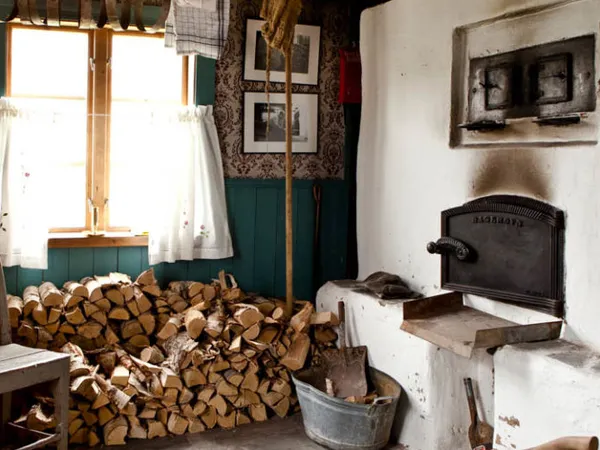
Tuomainengården, or Viinikkagården — both named after their owners — is a Kven town farm from the 1840s with a dwelling, cowshed/stable, sauna, bakery, shop and smithy. Tuomainengården was a Varanger house with the cowshed and dwelling under the same roof, but it also had several other buildings. The house has belonged to Vadsø museum – Ruija kvenmuseum since the 1980s. Tickets and guided tours are available at Esbensengården in the neighbourhood.
Source: Vadsø museum – Ruija kvenmuseum
Landhuselva
The river got its name because the first houses on the mainland were built here, from around the 1650s. The house or houses may have been used for herding livestock. Out here by the river in Ytrebyen there may have stood a house or two «in the country» for the herders. This river also marked the eastern boundary between the town municipality of Vadsø and Nord-Varanger municipality until 1963.
Source: Vadsø museum – Ruija kvenmuseum
The sea sheds in YtrebyenYtrebyfjæra
On the shore at Ytrebyfjæra there is a well-preserved group of old sea sheds. The oldest date from the mid-1800s, when this part of town was built up. All of them have been used as gear sheds, but they may also have been used to store flour bought from Russian merchants from the White Sea. In spring some were also used as fishermen’s lodgings during the seasonal fishery. The sheds are reminiscent of those along the rivers of Russia and Karelia.
Source: Vadsø museum – Ruija kvenmuseum
→ If you have time, we recommend a visit to Horisontti Sauna, right at the end of the breakwater.